Best CSPM Tools 2026: Defender for Cloud vs Wiz vs Orca vs Prisma Cloud
Compare Defender for Cloud, Wiz, Orca, and Prisma Cloud using documented deployment models, a practical proof-of-concept worksheet, and remediation evidence.
Quick answer
Choose a CSPM tool by testing required cloud coverage, approved permissions, remediation ownership, and exportable evidence in your environment. Defender for Cloud, Wiz, Orca, and Prisma Cloud use different deployment models; verify the exact edition and modules rather than relying on a universal ranking.
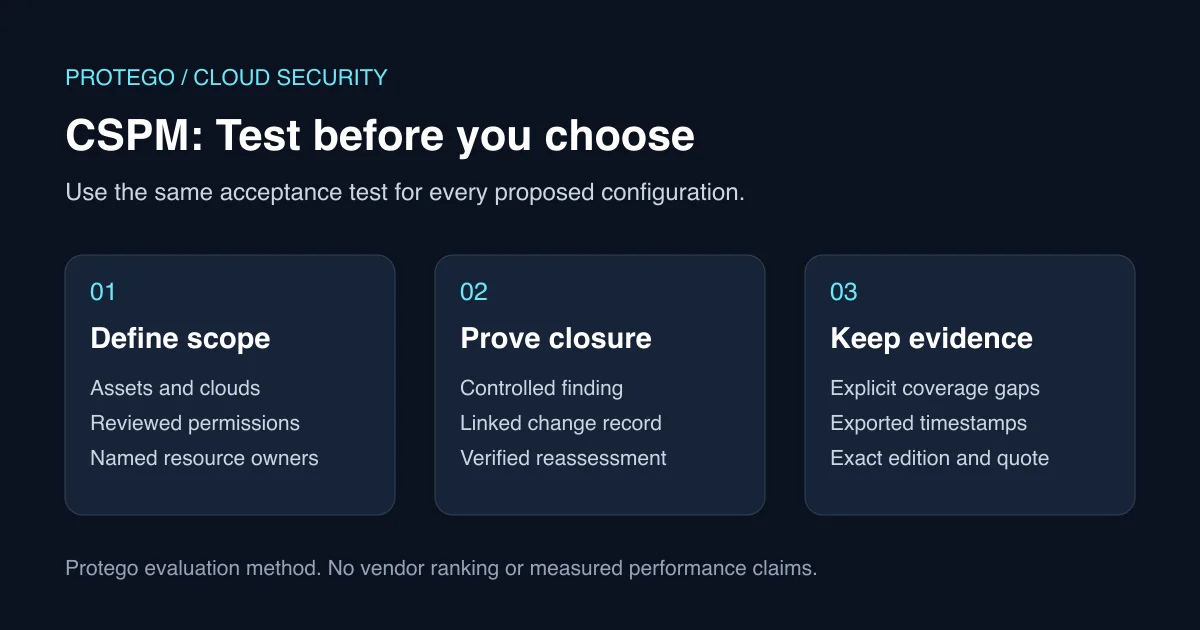
Choose a CSPM tool by asking each shortlisted vendor to demonstrate the same risks, permissions, and remediation workflow in your environment. Defender for Cloud, Wiz, Orca, and Prisma Cloud have different deployment models. A feature list alone cannot establish which one will cover your estate or fit your team.
This comparison uses public vendor documentation checked on October 11, 2026. It is not a hands-on performance benchmark. The evaluation worksheet below is Protego's proposed method; the scenarios are illustrative, not measured vendor results.
Start with the decision you need to make
Write one sentence describing the problem before booking a demo. For example: “We need to find exposed cloud workloads, assign each finding to its infrastructure owner, and retain proof that the fix survived a rescan.” That gives the evaluation an observable finish line.
Separate configuration assessment from runtime response. Knowing that a workload has a vulnerable package is a different requirement from detecting a running process or blocking a connection. If you require both, specify both and ask which licensed modules and deployment components deliver them.
Make a short inventory of your cloud accounts, subscriptions, projects, regions, workload types, and deployment pipelines. Include managed services and ephemeral resources. An impressive demo against one virtual machine does not prove coverage of that inventory.
What the four platforms document
Microsoft Defender for Cloud
Microsoft distinguishes free foundational CSPM from the paid Defender CSPM plan. Its documentation describes posture assessment across Azure, AWS, and Google Cloud, with capabilities dependent on the connected environment and enabled plan. Paid capabilities include attack-path analysis and risk prioritization. Review the current support matrix and connector requirements before assuming a feature works identically across providers. Microsoft Learn: CSPM in Defender for Cloud.
For your evaluation, ask an Azure owner to explain the existing configuration, then test the AWS or Google Cloud connector if those clouds are in scope. Record the enabled plans and the permissions used. An existing Microsoft relationship is a reason to investigate integration, not evidence that every required control is already enabled.
Wiz
Wiz's evaluation FAQ describes agentless cloud assessment and its Security Graph, alongside Wiz Code for development workflows and Wiz Defend for runtime capabilities using a lightweight eBPF sensor. These are vendor descriptions, not independent performance results. “Agentless” therefore needs a module-specific explanation when runtime detection is part of the proposed package. Wiz evaluation FAQ.
Ask the vendor to follow one finding from discovery through risk context, ownership, and closure. If the proposal includes runtime coverage, inspect the sensor deployment and supported workloads separately from the cloud API connection. Have your engineers validate the repository or ticket integration using a real test team.
Orca Security
Orca describes SideScanning as out-of-band workload inspection using block-storage data to reconstruct a read-only view of a workload's filesystem. That explains an inspection mechanism; it does not establish complete coverage of every service or runtime event. Review optional components and permissions for the specific product configuration offered. Orca SideScanning.
Ask which resources are discovered through APIs, which require workload inspection, and which remain outside the proposed coverage. Test a resource that cannot be inspected by the chosen mechanism. The product should make the missing coverage visible rather than allowing a buyer to confuse an empty finding list with a clean workload.
Prisma Cloud and the Cortex Cloud transition
Palo Alto Networks' Prisma Cloud workload-protection page describes both agentless scanning and agent-based protection. The page also introduces Cortex Cloud as bringing together cloud detection and response with the next version of its CNAPP. Confirm the product name, edition, migration terms, and modules in the current proposal rather than purchasing against a legacy comparison table. Palo Alto Networks: cloud workload protection.
If runtime prevention is required, ask for a demonstration of the deployed component, policy operation, alert evidence, and rollback process. Keep the posture-management test distinct from the prevention test so that success in one is not counted as proof of the other.
A comparison table for your proof of concept
Use this table as a record of evidence, not a vendor ranking. Fill it once per proposed configuration. A vendor can receive different results for different editions or cloud environments.
| Evaluation gate | Evidence to collect | Pass condition you define |
|---|---|---|
| Inventory coverage | Expected resources compared with discovered resources; explicit exclusions | Required resource types and regions are covered, with documented gaps |
| Permissions | Connector roles, trust policies, inspection permissions, and any write permissions | IAM owner approves the actual granted access |
| Risk context | One controlled finding traced to exposure, identity, and affected workload | Analyst can explain the priority using inspectable evidence |
| Remediation workflow | Finding assigned to a named team, linked to a change, and rescanned | Owner can close the loop without losing the evidence |
| Runtime requirement | Deployed component, event record, policy behavior, rollback | Required detection or prevention works safely in the agreed test |
| Evidence export | Exported finding, timestamps, exception record, and closure state | Records support the team's review process outside the dashboard |
The CSA Cloud Controls Matrix provides a neutral framework for cloud controls and responsibility. You can map your requirements to it. A framework mapping in a product dashboard does not by itself prove that your organization has implemented a control or achieved compliance.
Run a controlled test from finding to closure
Use an isolated account or subscription you own. Agree on permissions, costs, cleanup, and a rollback owner before adding test resources. Avoid introducing public access to production systems just to create a finding.
- Record the expected inventory before connecting the product. Include a resource type that matters to your business and one known coverage limitation.
- Introduce a reversible configuration issue in the isolated environment. Keep a timestamped record of the original and test configuration.
- Check discovery and finding evidence. Record when the resource became visible, when the finding appeared, and what permissions were needed. These are your observed times, not vendor-wide benchmarks.
- Assign the finding to the team that can fix it. Ask that team to use its normal change process and retain the ticket or pull-request reference.
- Correct the issue, then request or wait for the documented reassessment. Record the new state and any delay. A closed ticket alone does not establish that the cloud configuration changed.
- Export the evidence and remove the test resources. Check that the report distinguishes remediated, accepted, excluded, and unassessed resources.
For a runtime requirement, use a separate approved test with a benign fixture. Begin with observation where the product supports it, review the generated evidence, and define how to restore service before trying prevention. The buyer's acceptance test must specify the required behavior and supported workload; a posture alert cannot substitute for a runtime event.
Price the configuration you tested
Request a written quote for the same resource scope and modules used in the evaluation. Record the billing unit, minimum commitment, included cloud environments, optional components, support level, and renewal terms. Include any cloud-side inspection or storage costs identified during the test.
Use an estimate of your own resource growth and ask how it affects the quote. Track the staff work needed to deploy components, review permissions, tune policies, and maintain integrations. These are planning inputs, not a published total-cost ranking.
Do not compare one vendor's entry plan with another vendor's full platform. If a required capability was demonstrated under a trial, verify that it is included in the proposed production license.
Common ways an evaluation gives the wrong answer
| Observation | Possible explanation to check | Next action |
|---|---|---|
| No findings on a workload | Unsupported inspection, missing permission, stale assessment, or a clean configuration | Verify coverage and assessment timestamps before concluding it is clean |
| Very high finding volume | Broad discovery, duplicate records, or weak prioritization for your context | Review a sample against your actual assets and owners |
| A risk is marked resolved | Ticket closure, exception, suppression, or verified remediation | Inspect the state transition and reassessment evidence |
| Runtime demo succeeds | A component or module was enabled only for the demo | Confirm the deployment and license in the production proposal |
| Compliance score improves | A configuration changed or the scoring scope changed | Preserve the control evidence and document the scope change |
Which tool should you shortlist?
Start with the platform that can demonstrate your required cloud coverage and ownership workflow using access your IAM team approves. Add alternatives where a requirement remains unproven. The documentation above identifies different operating models; it does not establish a universal winner, market-share leader, fastest deployment, or lowest price.
If you are learning before buying, use Protego's free Defender for Cloud lesson linked on this page to practice the underlying posture concepts. A course is a learning aid; the purchase decision still needs evidence from your own environment.
Questions to settle before signing
Is agentless assessment enough? Only if it satisfies your stated requirements. Ask separately about inventory, workload inspection, runtime detection, and prevention. The answer can depend on the module and resource type.
Can the same product cover several clouds? Test the providers, regions, and managed services you actually use. A multicloud label is not a substitute for a support matrix and verified connector access.
Can a CSPM tool prove compliance? It can contribute evidence. Your organization still needs to establish control ownership, assess scope, document exceptions, and complete its assurance process.
What should the final decision record contain? The tested edition, scope, granted permissions, unresolved gaps, workflow evidence, quote, operational owner, and reasons for accepting the remaining risks. Retain the unsuccessful tests too; they explain why a particular configuration was rejected.
Reader desk
Discuss this guide
Rate the guide or ask a practical follow-up. Clear questions publish immediately; uncertain submissions wait for review.
Microsoft Cloud Solution Architect
Cloud Solution Architect with deep expertise in Microsoft Azure and a strong background in systems and IT infrastructure. Passionate about cloud technologies, security best practices, and helping organizations modernize their infrastructure.
Share this article
Licensed under CC BY 4.0: you may share and adapt this article with attribution to Protego.

